

Free · no sign-up · 50/30/20 budget
Free budget planner
Budget Planner: the 50/30/20 Rule
Put 50% of your take-home pay toward needs, 30% toward wants and 20% toward savings and debt payoff. Enter your monthly pay and your bills below to see where you stand, then download your budget as Excel, Word or PDF. Free, no sign-up.
By Anthony L. Hammock, M.Sc., founder of BlissPoint Access, 20+ years as an Industrial and Organizational Psychology consultant and software developer · Updated November 17, 2026
How It Works
1. Enter your take-home pay
Type what lands in your bank each month after taxes and payroll deductions, then press Enter.
2. Answer one bucket at a time
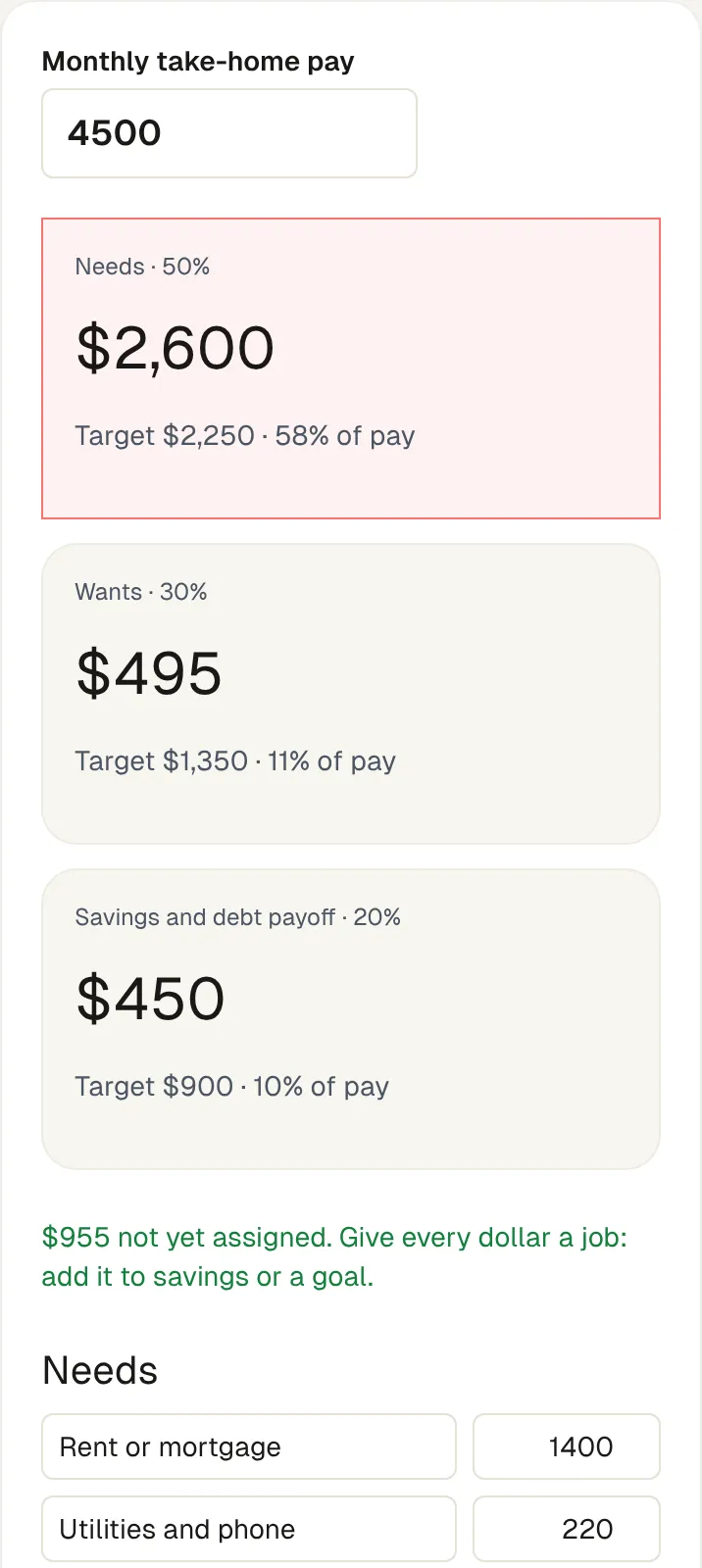
Needs, then wants, then savings: edit the sample lines, tap a suggestion or add your own. The donut and bars update as you type.
3. Fix what is over
The On target score and coaching tip show what to change first. Trim wants first, then needs at your next lease or renewal.
4. Download and keep it
Download a real Excel file with live totals, a Word file or a PDF. Nothing is uploaded.
What It Looks Like on Your Phone
Keep going, free
Questions
- What is the 50/30/20 budget rule?
- Split your take-home pay three ways: 50% to needs (housing, food, utilities, insurance, minimum debt payments), 30% to wants (dining out, subscriptions, travel) and 20% to savings and paying debt down faster.
- Should I use take-home pay or gross pay?
- Take-home pay: what lands in your bank after taxes and payroll deductions. If retirement savings come out of your paycheck, you can count them in the 20%.
- What if my needs are more than 50%?
- Common in high-rent cities. Lower wants first, keep at least some savings every month, and plan to bring needs down at your next lease or refinance.
- Is this budget planner free?
- Yes, with no sign-up. Your numbers are saved only in this browser. Download them as Excel, Word or PDF any time.
- Does it work for a small business owner?
- Use it for your personal pay. For the business side, BlissPoint Budgets tracks spending by category against plan, from $10 a month with 14 days free.
- How much should go to rent?
- Rent sits inside the 50% for needs. If rent alone is more than about a third of take-home pay, other needs get squeezed, so plan the rest around it.
- Is my budget saved?
- Only in this browser, on this device. Download it if you want a copy elsewhere.
- Does this work for irregular income?
- Use your lowest normal month as take-home pay. Put anything above it straight into savings.
- Why one login?
- BlissPoint Access runs deal → invoice → books → taxes in one account. Each sale becomes an invoice, each payment lands in your books, and your books feed your tax summary, so nothing is retyped between apps. Plans are $10, $25 or $50 a month with every tool, 14 days free, no card.